
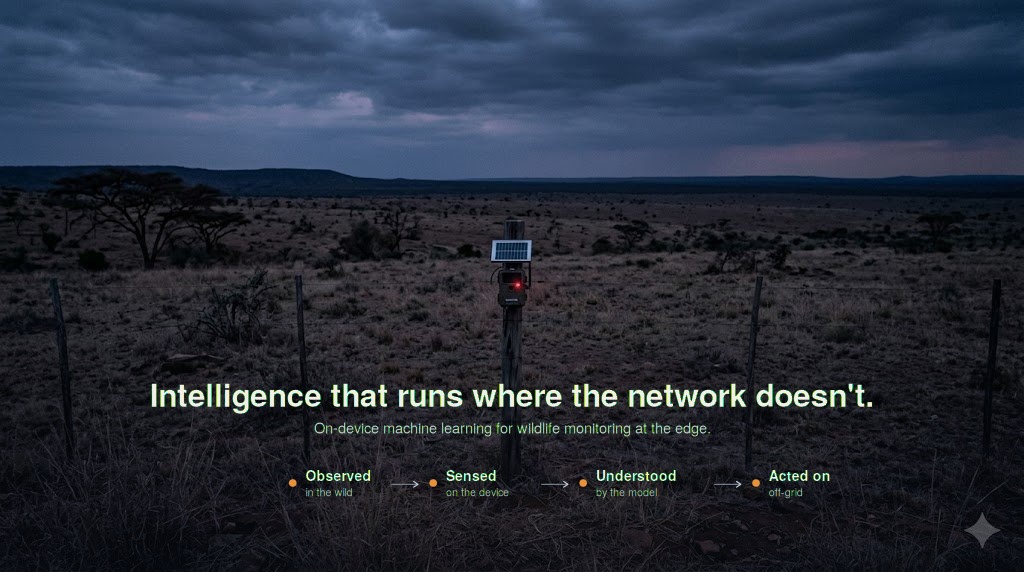
PhD candidate, Paul G. Allen School of Computer Science, University of Washington. I build efficient, on-device machine learning for places with no power budget, no network, and little context — wildlife camera traps in remote landscapes. BS/MEng, MIT.
Open to industry ML / research roles.
The problem I work on
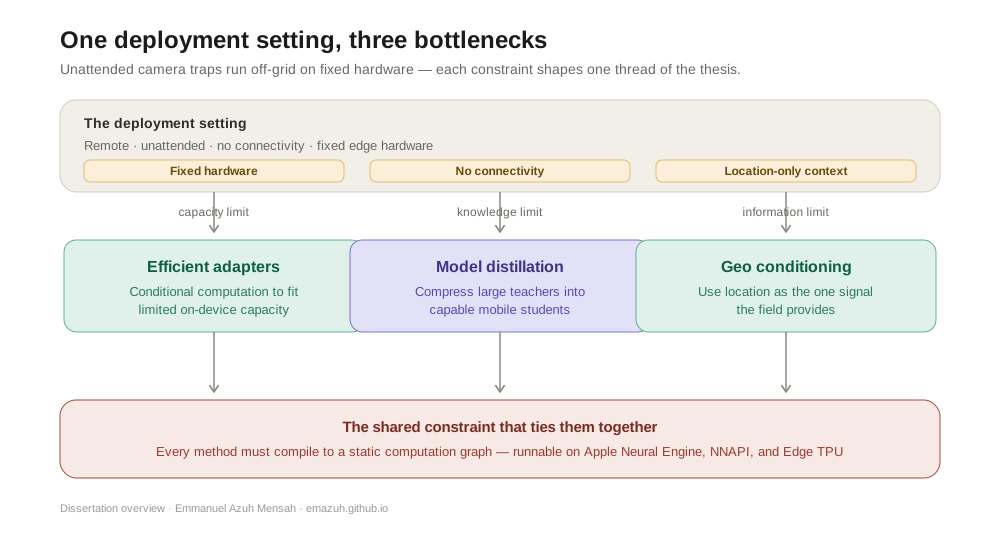
My dissertation tackles a single question: how do you run capable machine learning in places with no power to spare, no network to reach, and no context but a GPS coordinate? Unattended camera traps in the field face exactly this — and each constraint shapes one thread of the work.
Selected projects
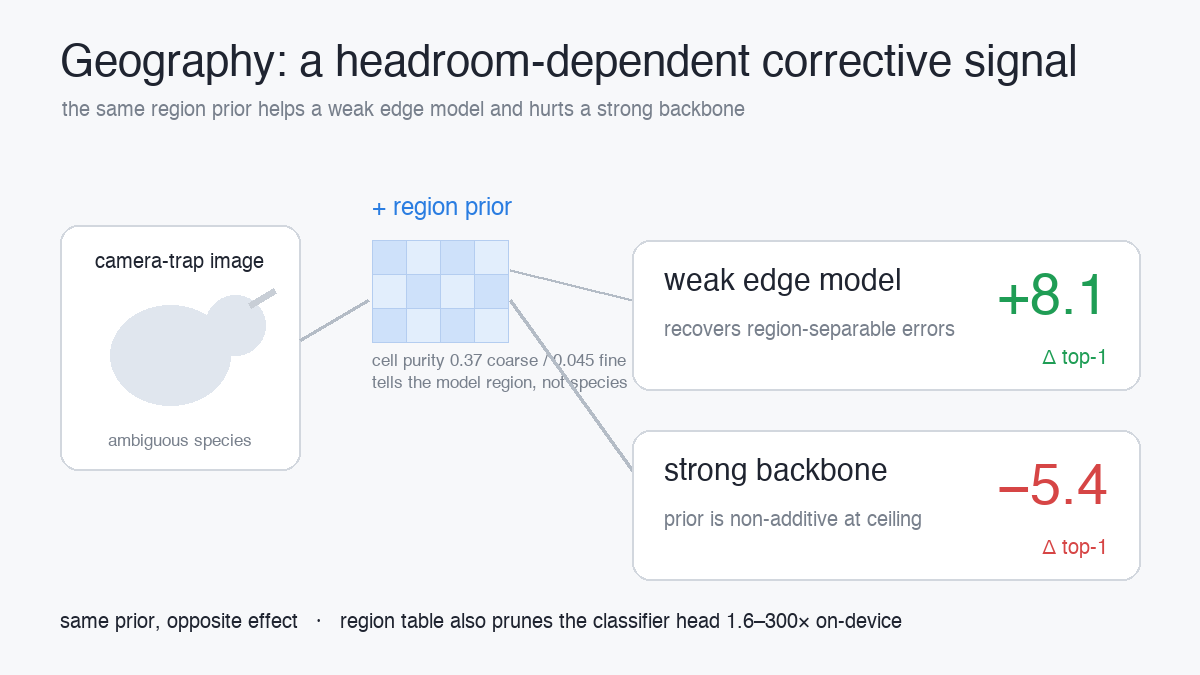
WACV 2027 · under review
TL;DR — Geographic priors help a weak on-device classifier (+8.1 top-1) but hurt a strong backbone (−5.4): a headroom-dependent sign flip. The same region structure prunes the classifier head 1.6–300× for microcontroller deployment.
Project page
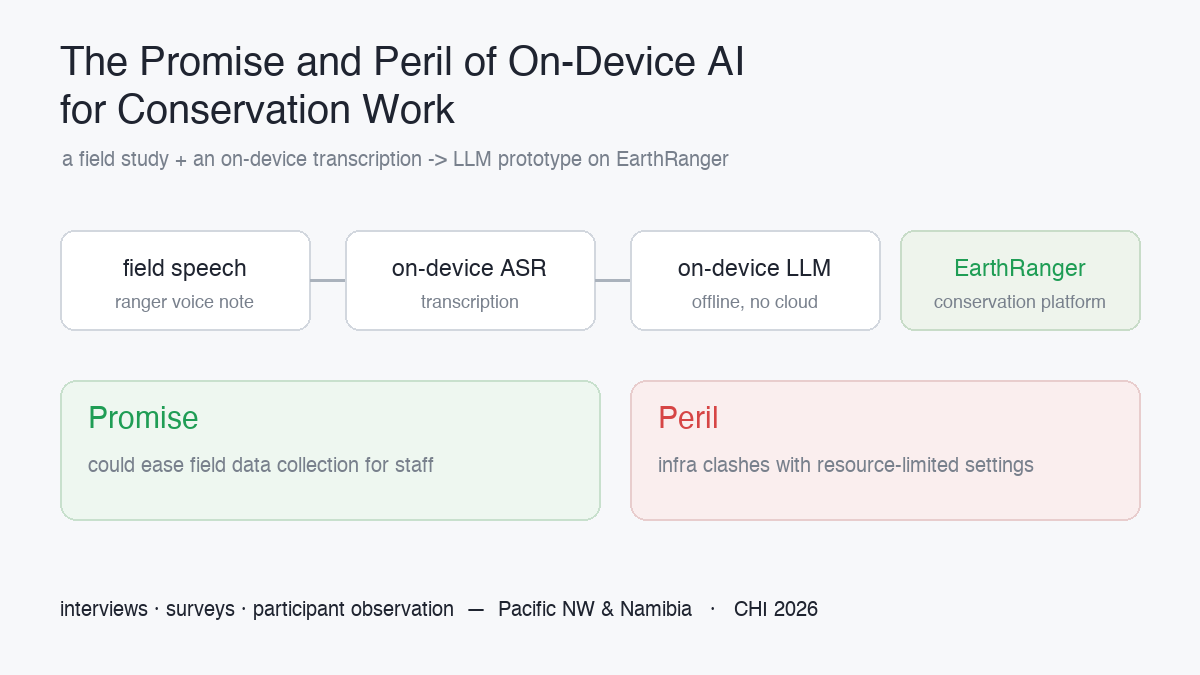
CHI 2026
TL;DR — A field study across Pacific Northwest & Namibia conservancies, paired with a working on-device transcription→LLM prototype on EarthRanger. On-device LLMs show promise for field data collection, but current models' infrastructure clashes with resource-limited conservation settings.
Project page Paper
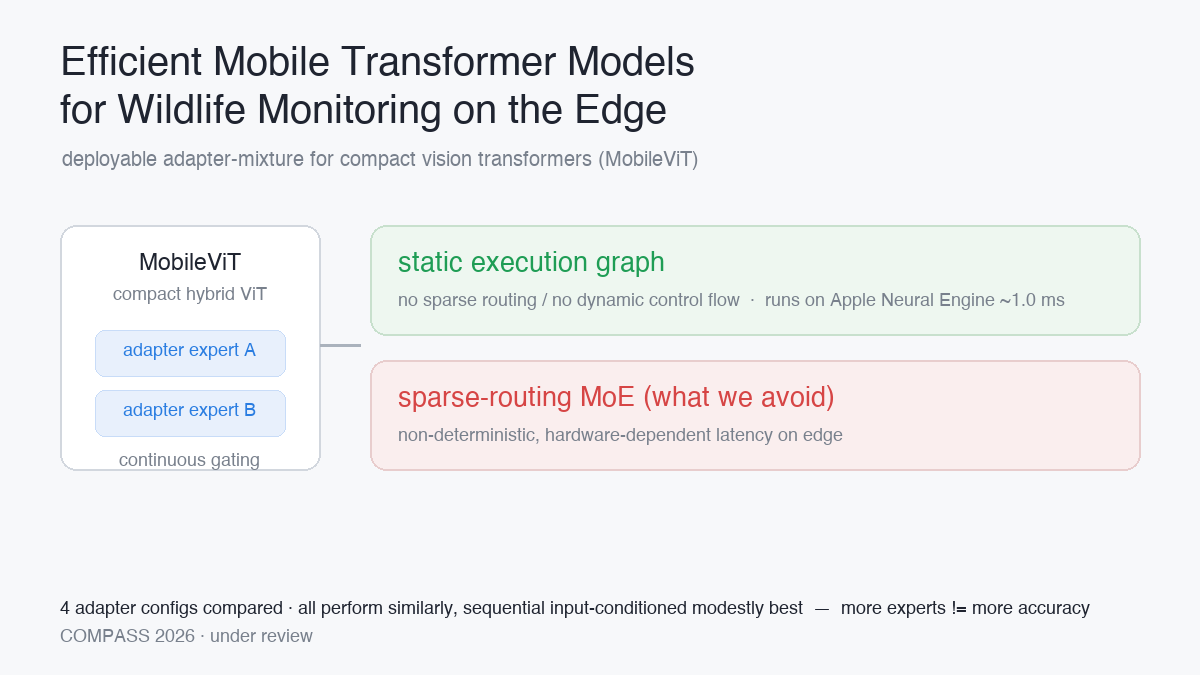
COMPASS 2026 · under review
TL;DR — Convolutional adapter experts on compact vision transformers (MobileViT), combined by continuous gating to keep a static execution graph for edge accelerators (Apple Neural Engine, ~1.0 ms). A controlled comparison of four adapter designs shows more experts is not a reliable path to more accuracy.
Project page
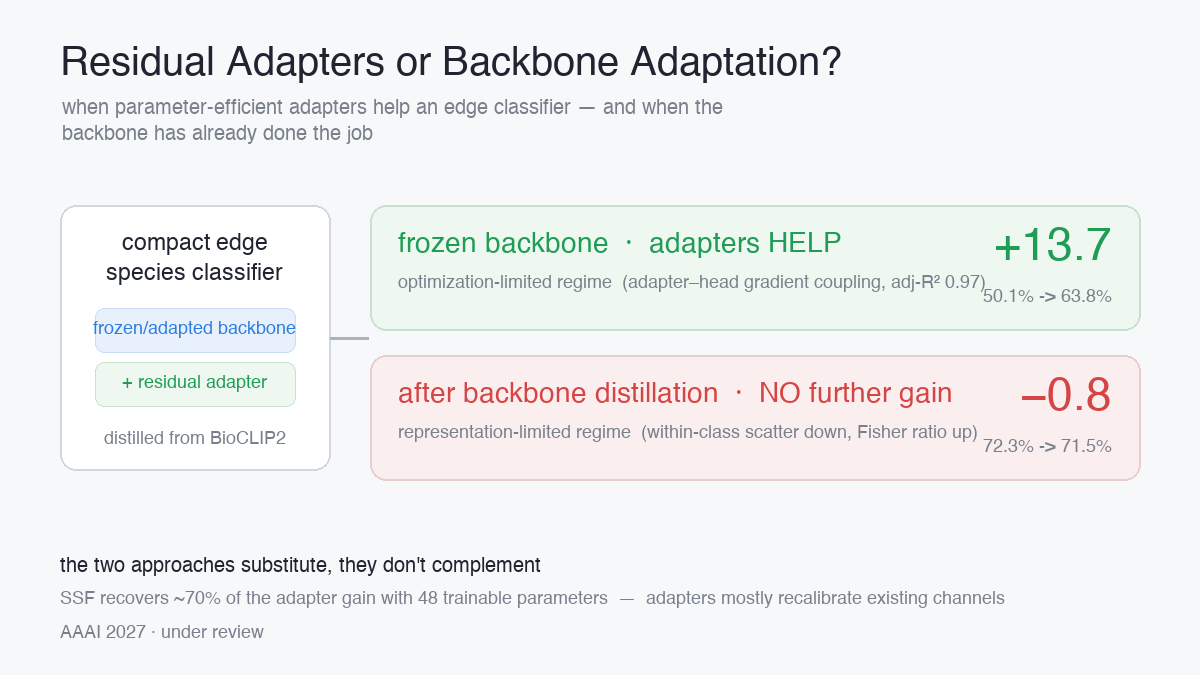
AAAI 2027 · under review
TL;DR — When compressing biological foundation models to the edge, residual adapters and knowledge distillation are usually combined — but they capture the same gain. Adapters add +13.7 pts on a frozen backbone yet nothing after distillation: the two substitute rather than complement.
Project page
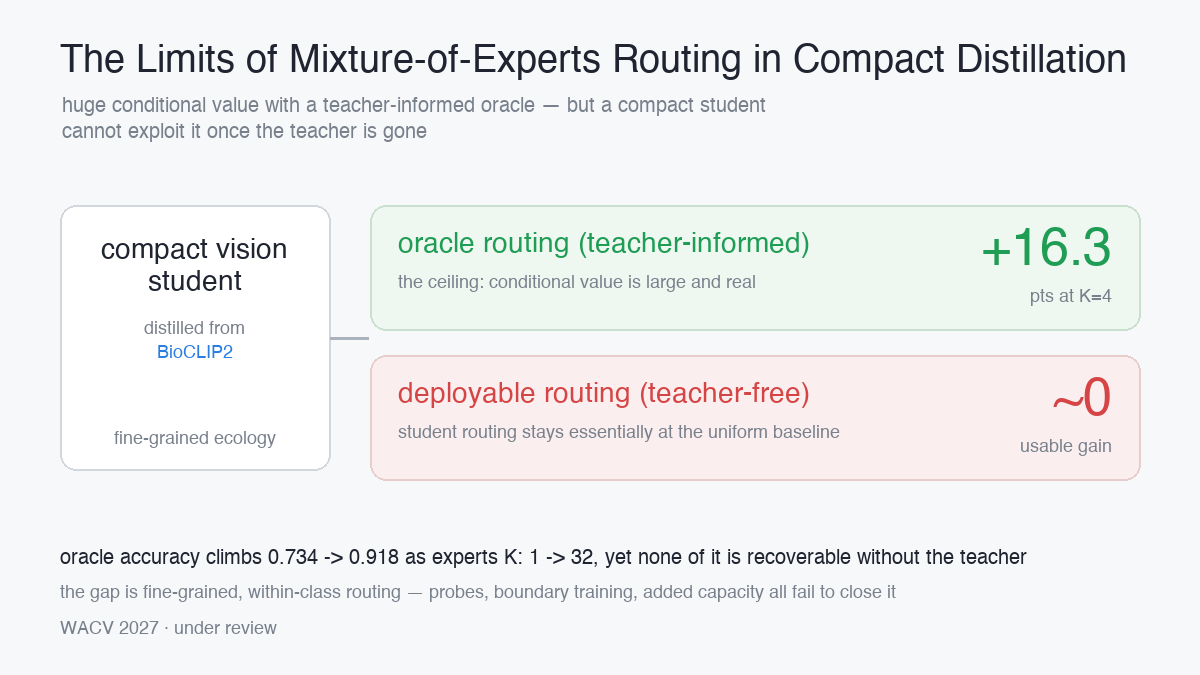
WACV 2027 · under review
TL;DR — With a teacher-informed oracle, MoE routing is worth +16.3 pts on a compact vision student — but without the teacher the student can't exploit it, and deployable routing stays at the uniform baseline. The exploitable gap is fine-grained, within-class routing.
Project page
Dissertation code is being open-sourced as each paper is released. Manuscripts for papers under review are available on request.
Active collaborations
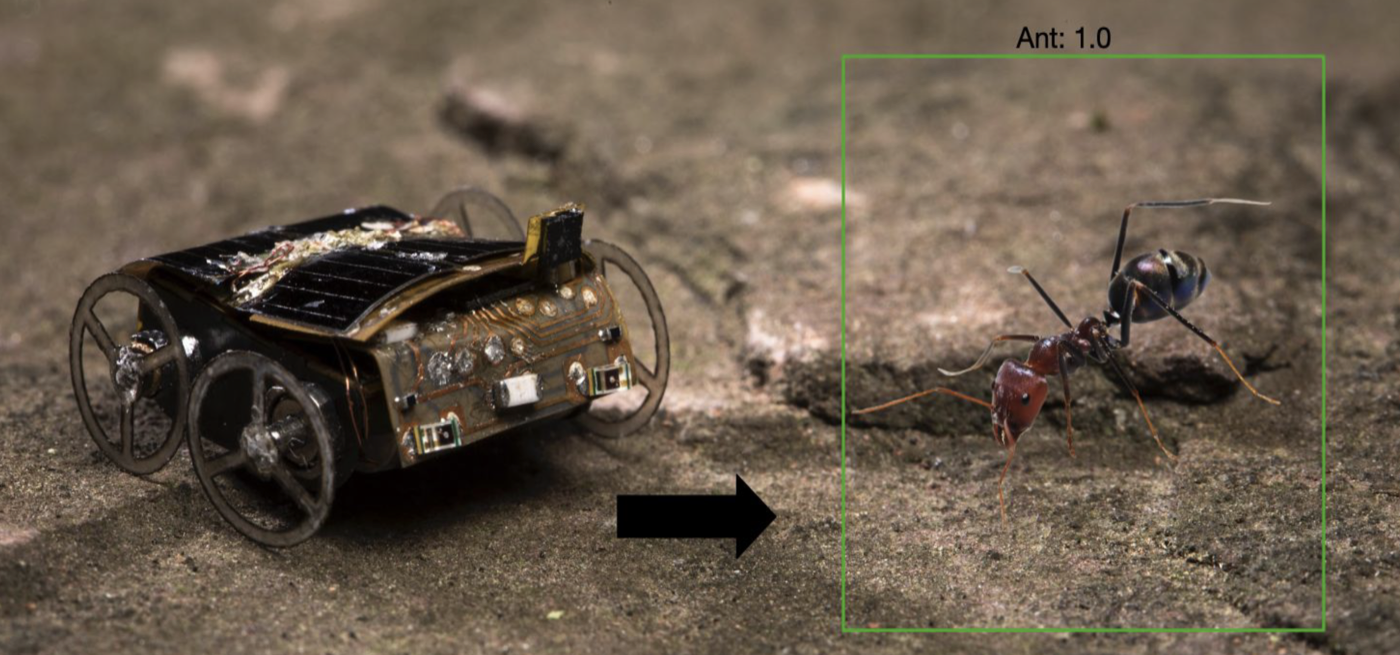
In progress · 2025
Battery-free insect detection & classification on solar-powered milli-robots with tiny ML for microcontrollers — with Kyle Johnson and Vicente Arroyos; late-breaking poster at IEEE ICRA.
Project page
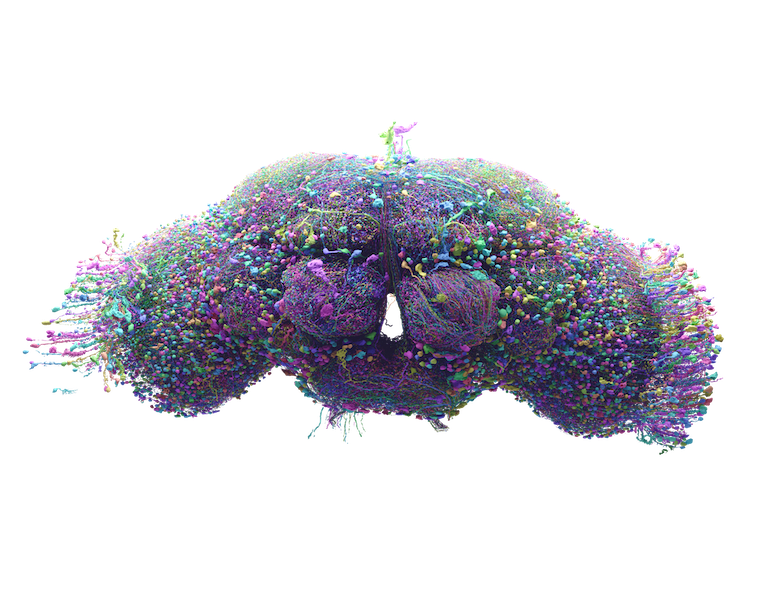
In progress · 2025
Neuroscience-informed heuristics (with UW neuroscientist Ian Quah) for searching ultra energy-efficient edge vision transformers via data-dependent subnetwork computation.
Project page
Highlights
CHI 2026 · TOCHI 2026 · Interspeech 2019 · IEEE Sensors 2018 · NAIRR Pilot · Azure AI for Earth grant · UW CS for the Environment Fellowship · Qualcomm Innovation Fellowship (selected abstract) · Created the vision unit of MIT’s Deep Learning Practicum (6.S198) · BS/MEng, MIT