
Efficient Mobile Transformer Models for Wildlife Monitoring on the Edge
COMPASS 2026 · under review
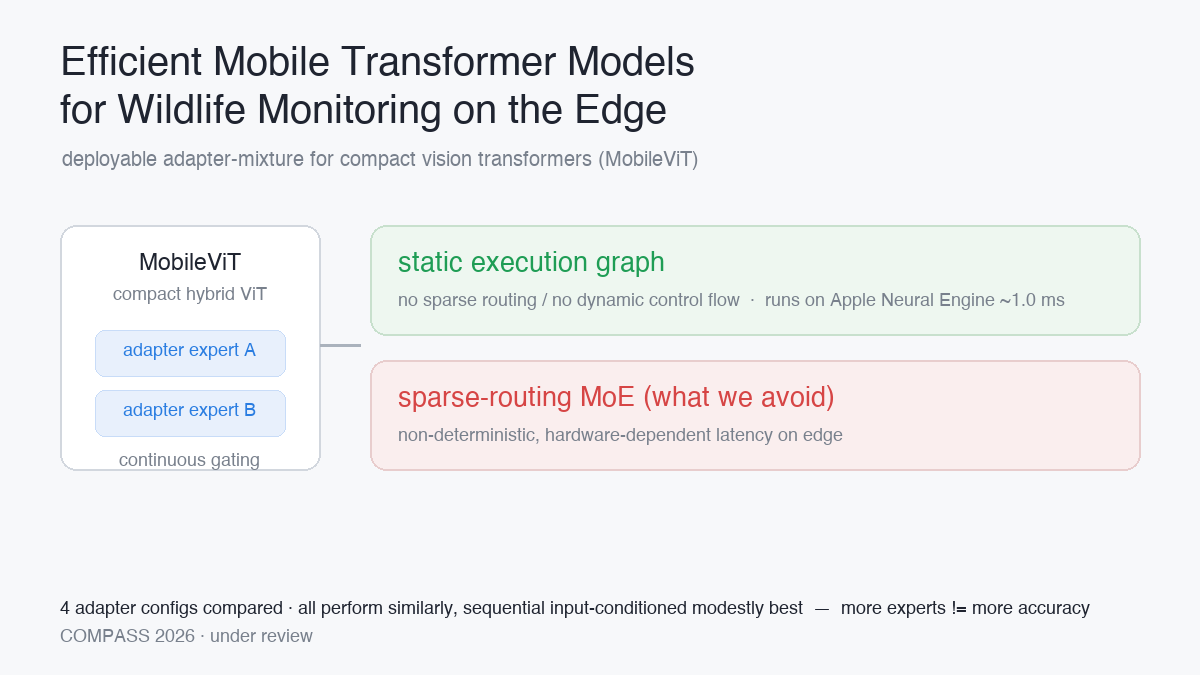
TL;DR — Vision models deployed in place (ecological monitoring, biodiversity sensing) must run under strict compute, energy, connectivity, and privacy limits. We add input-dependent adaptability to compact vision transformers (MobileViT, EfficientFormer) using lightweight convolutional adapter experts combined by continuous sigmoid gating — deliberately avoiding the sparse routing and dynamic control flow that break deployment on edge accelerators. This keeps a static execution graph (e.g., Apple Neural Engine, ~1.0 ms). A controlled comparison of four adapter designs shows they perform similarly, with a modest, consistent edge for sequential input-conditioned adapters — i.e., more experts is not a reliable path to more accuracy on edge vision.
Why this problem
Many edge deployments fail not because of insufficient benchmark accuracy, but because of brittleness, unpredictable latency, or hardware incompatibility. Expert- and mixture-style adapters promise input-dependent capacity, but the usual machinery — softmax routing, sparse expert activation, dynamic control flow — introduces non-deterministic execution and hardware-dependent performance that undermine long-running monitoring systems.
The approach: HyViT–AdapterMixture
- Wrap the last stages of a hybrid compact ViT (MobileViT / EfficientFormer) with lightweight convolutional adapters.
- Combine them with continuous sigmoid gating rather than top-k routing — so the whole model stays a static, deterministic graph deployable on mobile accelerators.
- Study adapter multiplicity as a lens on adaptive capacity under edge constraints, not as a guaranteed accuracy lever.
What we found
A systematic comparison of four adapter composition strategies — parallel / sequential × input-conditioned / fixed — on biodiversity-recognition benchmarks under mobile-scale conditions, across multiple seeds:
- All configurations perform similarly, with a modest but consistent preference for sequential input-conditioned adapters.
- Much of the benefit does not come from increasing the number of experts.
- The result clarifies the practical limits of expert-style adapter mixtures for edge vision, and offers guidance on adapter design for deployment-oriented ecological monitoring.
Paper is under review — the manuscript is available on request. The preprint, code, and BibTeX will be linked here once the review period closes.