
Understanding the Limits of Mixture-of-Experts Routing in Compact Wildlife Vision Distillation
WACV 2027 · under review
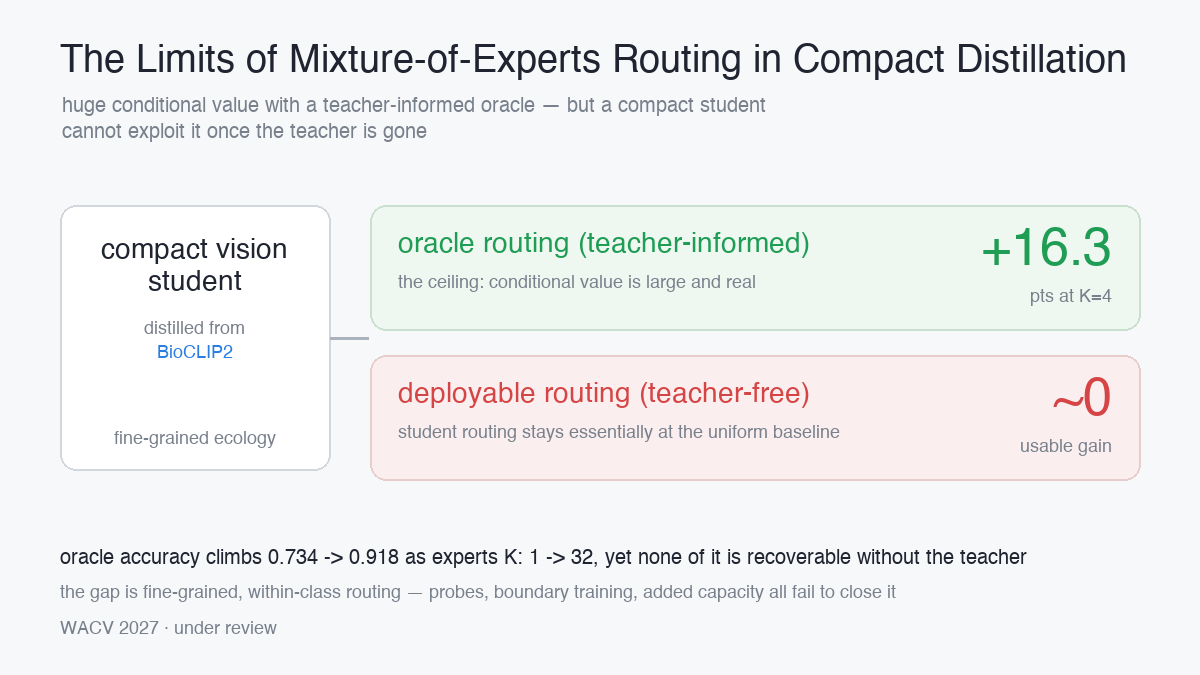
TL;DR — Mixture-of-experts (MoE) architectures promise higher effective capacity through input-dependent specialization. Does that advantage survive in a compact vision student under limited data and compute, after standard distillation has converged? Using a BioCLIP2 teacher-informed oracle, we show the conditional value is large and real — +16.3 points at K=4 over uniform routing, with oracle accuracy climbing 0.734 → 0.918 as experts grow from K=1 to K=32. But without the teacher, a compact student cannot exploit it: deployable routing stays essentially at the uniform baseline. We identify a scoped empirical limit on fine-grained routing exploitability, not evidence that conditional computation is intrinsically ineffective.
The question
Biodiversity monitoring increasingly runs species recognition on camera traps and edge sensors under tight memory, latency, and energy budgets. Large biological vision models (e.g., BioCLIP2) give strong fine-grained recognition but are too costly to deploy; compact students are deployable but lower-capacity. MoE is a natural way to recover accuracy by letting different inputs use different experts — so: can conditional computation recover excess accuracy after standard feature distillation, without sacrificing deployability?
What we found
- The ceiling is high. An oracle that routes with teacher information delivers large gains (+16.3 pts at K=4), and oracle accuracy rises steadily with more experts (0.734 → 0.918). Parameter-matched uniform banks stay nearly flat — the value is genuinely conditional, and the effect reproduces across compact backbones and datasets.
- Students can’t reach it. Student representations retain routing-relevant structure, but most recoverable expert identity is class-mediated, while deployable routing sits near the uniform baseline. The gap is concentrated in fine-grained, within-class routing.
- The gap is stubborn. Nonlinear probes, boundary-focused training, added student capacity, true-class conditioning, and teacher-representation reconstruction all fail to recover useful additional routing.
- It’s the soft weights, not just the choice. Interpolation and choice–concentration analyses show the conditional value depends strongly on the soft mixture weights, not simply on which expert is selected.
Why it matters
Compact students can preserve coarse conditional structure while failing to exploit the finer distinctions that make teacher-shaped expert banks valuable. That’s a concrete, scoped limit for anyone hoping MoE routing will cheaply recover accuracy in compact, low-data edge distillation — and a map of which recovery strategies don’t work.
Paper is under review — the manuscript is available on request. The preprint, code, and BibTeX will be linked here once the review period closes.