
The Promise and Peril of On-Device AI for Conservation Work
CHI 2026 · Cynthia Dong, Emmanuel Azuh Mensah, Vaishnavi Ranganathan, Kurtis Heimerl
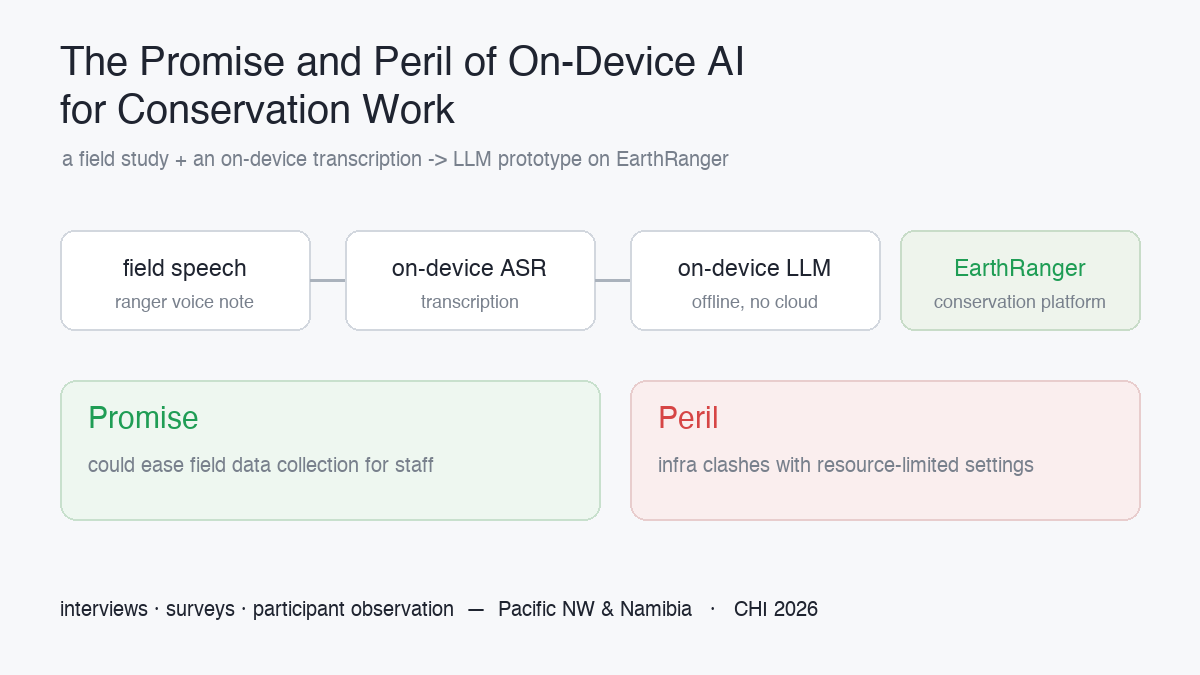
TL;DR — Could on-device LLM assistants help the field staff who study and monitor ecosystems? We pair a field study (interviews, surveys, and participant observation across conservancies in the Pacific Northwest and Namibia) with a working on-device transcription→LLM prototype built atop EarthRanger. Using technology-acceptance theory, we find on-device LLMs hold real promise for field data collection — but the infrastructure current on-device models demand clashes with the reality of resource-limited conservation settings.
The question
At the heart of conservation are the field staff who study and monitor ecosystems in challenging environments. Recent advances in AI raise a tempting question: could LLM assistants improve the experience of data collection for these staff? Yet on-device AI deployment for conservation field work is understudied — and the constraints (power, connectivity, privacy) are unforgiving.
What we did
- Grounded field research — semi-structured interviews, surveys, and participant observation with partner conservancies in the Pacific Northwest and Namibia, to understand the real texture of field work.
- A concrete prototype — an on-device transcription-language-model pipeline built on EarthRanger, a widely-used open-source conservation platform, so the analysis is grounded in a real system rather than a hypothetical.
- A critical lens — speculative methods through technology-acceptance theory, to analyze how on-device AI would actually land in the field.
What we found
On-device LLMs hold some promise for field work — but the promise is conditional. The compute, memory, and energy footprint of current on-device models clashes with the resource-limited reality of many conservation deployments. The contribution is a clear-eyed account of both the opportunity and the mismatch, rather than an uncritical push for deployment.