
Residual Adapters or Backbone Adaptation? Understanding Their Interaction in Edge Wildlife Vision Classifiers
AAAI 2027 · under review
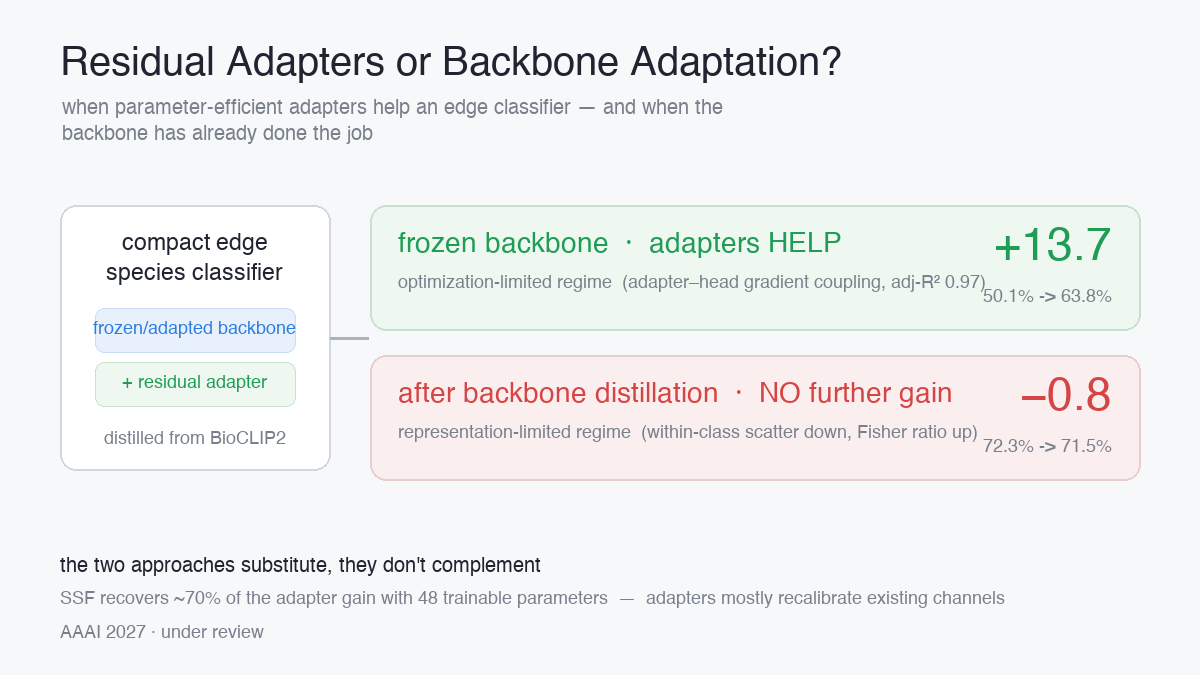
TL;DR — Deploying biological foundation models (e.g., BioCLIP2) on edge devices needs compact students that stay accurate. Two adaptation strategies — residual adapters (add lightweight trainable modules to a frozen backbone) and backbone adaptation via knowledge distillation — are usually combined. We show they capture largely overlapping improvements: on a frozen backbone, adapters add +13.7 pts (50.1% → 63.8%); after backbone distillation they add nothing (72.3% → 71.5%). The two approaches substitute, they don’t complement — and we give a practical framework for choosing between them.
The problem
Edge-based ecological monitoring runs species classification on camera traps, acoustic sensors, and microcontrollers — with no cloud, and strict memory, latency, and energy budgets (Coral Edge TPU, Cortex-M). Biological foundation models like BioCLIP2 are state-of-the-art but far too large; compact models are deployable but much less accurate. Practitioners reach for adapters and distillation together, assuming the gains stack.
What we found
- A continuous substitution relationship. Across progressive distillation checkpoints, adapter gains decrease monotonically as the backbone’s features become more discriminative — the two techniques address the same limitation, not independent ones.
- Two operating regimes. With a frozen backbone, adapter utility is optimization-limited and tracks adapter–head gradient coupling (adj-R² = 0.97). After backbone adaptation, performance is representation-limited: as within-class scatter falls and the Fisher ratio rises, adapter gains vanish — across architectures, objectives, and datasets. A plain cross-entropy backbone shows the same trend, so the effect isn’t specific to distillation.
- A mechanistic reading. A simple Scale-and-Shift Fine-Tuning (SSF) baseline recovers ~70% of the frozen-backbone gain with only 48 trainable parameters — evidence that adapters mostly recalibrate existing feature channels rather than learn new ones.
- Distillation choice depends on data structure. Hierarchical taxonomic datasets benefit from intermediate feature alignment; scene-dependent camera-trap datasets favor logit distillation, because teacher features encode environmental context that’s lost once detections are cropped.
- Generalizes across MobileViTv2, MobileNetV2, and ultra-small microcontroller-scale networks.
Why it matters
Together these results give a practical framework for when to spend parameters on adapters versus improving the backbone itself — guidance for anyone compressing biological foundation models onto resource-constrained edge hardware.
Paper is under review — the manuscript is available on request. The preprint, code, and BibTeX will be linked here once the review period closes.